

A Mysterious Dream
The Mystery of Dreams and the Architecture of Time

It’s been a while, and it feels good to be back writing on a fine Sunday morning. It’s chilly outside, and I’ve been thinking about dreams.
Recently, a friend of mine who had disappeared for a few days texted me quite early in the morning with an intriguing message. She told me I’d made a surprising appearance in her dream, though she couldn’t recall what it was about. Then she asked me: did I remember any of my dreams? That question has stayed with me, because there’s something deeply puzzling about our memory of dreams that I’ve always wondered about.
What’s up with our memory of dreams?
We recognize that something has genuinely happened, that we’ve experienced something real, yet unlike our waking experiences, dreams fade away remarkably fast. You wake up with fragments, pieces of a narrative that felt complete just moments ago, but already the edges are dissolving like morning mist. Even stranger, in such a short period of time, although you can only recall a couple of pieces of that dream, it feels like you experienced a whole lot more. There’s a compression, a density to dream experience that defies our usual relationship with memory.
I’ve also noticed something particular about the people in my dreams. The faces of participants are always really blurry. Not even once have I been able to clearly see them. It’s as if my sleeping mind can conjure entire worlds, complex narratives, and emotional landscapes, but it struggles with the specific details of human faces. Why is that? What does it tell us about how our brains construct and store these nocturnal experiences?
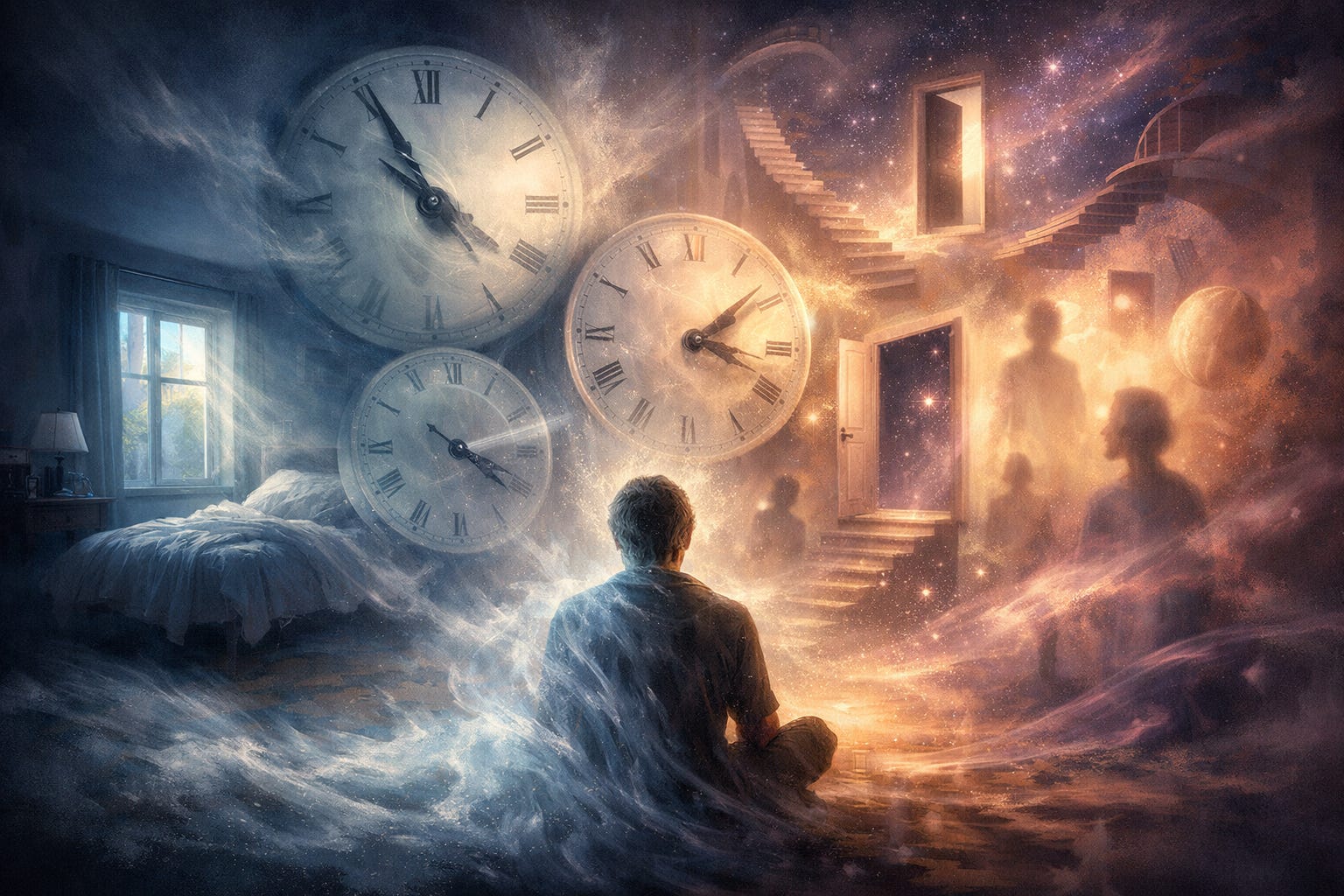
And then there’s the temporal mystery. We can’t map dreams onto the time that might have actually passed. A dream that feels like it spans hours or even days might occur in just fifteen minutes of sleep. The subjective experience of time within a dream bears almost no relationship to the clock ticking beside your bed.
Capture the Uncapturable
This brings me to something I’ve been imagining: what if we could create a product that somehow syncs with our brains as we sleep and records these dreams, which we could then play back later as if watching a movie? Apart from being a brilliant product, it would help us understand our human brains better, revealing how our thoughts and emotions are connected to our dreams. I plan to go down the rabbit hole to search if any efforts have been made for such a device, but if it became possible, it would be a massive step towards understanding our subconscious.
I’ve always envisioned that when we sleep, our brain digests all the information we’ve captured from all our senses during the day. Dreams might be the byproduct of this processing, or perhaps they’re something more intentional, a way the mind works through problems, emotions, and experiences. A dream recording device wouldn’t just be entertainment or a curiosity. It would be a window into the most private theater of the mind, where our psyche works out its deepest concerns.
Directed by Nolan
But there’s another dimension about dreams that I find even more fascinating: the speed of time. As I mentioned, it feels like a lot has happened in a dream, but when you actually come to your senses, it’s difficult to measure how long you’ve been dreaming in real time. This disconnect hints at something profound about consciousness itself.
What if we could take this further? What if I could transfer my consciousness into a dream, a real-life inception, but because it’s my dream, I should be able to control the speed of time relative to the speed of actual time in the outside world? Imagine a real-life Interstellar scenario, where one day in the outside world could be many years in a space that you control. You could live entire lifetimes of experience, learn skills, solve problems, or simply exist in ways impossible in our physical reality, all while your body rests for a single night.
In fact, I have read about such phenomena in Indian as well as Chinese mythologies. Ancient stories tell of sages who enter meditative states and experience eons of time, or of celestial realms where time moves differently than on Earth. I have a strong feeling that even this seemingly impossible idea is, or will be, possible. Perhaps those ancient stories weren’t mere fantasy but intuitions about the true nature of consciousness, hints at capabilities we’ve yet to unlock.
The question isn’t just whether we can record dreams, but whether we can eventually inhabit them fully, consciously, and bend their temporal fabric to our will. If consciousness is not bound to the physical constraints of our waking world, then dreams might be the first frontier in humanity’s exploration of time itself.
That’s a wrap for today. I hope you enjoyed reading the article, understood it, and before I say goodbye for today, here’s a quote I’ve been pondering,
“It is not our job to hold anyone accountable to the people they used to be. It is our job to travel with them between each version and to honor what emerges along the way."
If you’ve made it this far, please don’t forget to share it with your friends, family, and strangers.
Have a Great Day 💖