

What's a Roofline Model?
notes on a visual performance model

It’s a regular Tuesday. You sit down, wiggle your mouse, and double-click an icon to open a file. Instantly, the document pops up on your screen. It feels like magic, right? We do it a hundred times a day without a second thought.
But let me tell you something to blow your mind: beneath that simple click, you just triggered a cascading avalanche of billions of tiny mathematical operations.
Everything your computer stores, processes, or displays is ultimately just numbers. When you clicked that file, your mouse sent an electrical signal of coordinates to your computer’s brain → the processor. The processor had to verify those numbers, fetch the data, calculate how to display it, and push it to your screen.
To understand how this actually works and why your computer sometimes slows down, we need to go down the rabbit hole into the architecture of modern computing.
The General Manager and the Specialist
First, let’s meet the brains of the operation. You generally have two types of processors:
The CPU (Central Processing Unit) is the general manager. It handles a bit of everything, let it be - running programs, moving files, orchestrating the system. Then you have the GPU (Graphics Processing Unit). This is the specialist. It is designed to perform many simple, similar tasks in parallel, making it ideal for rendering graphics or processing massive datasets simultaneously.
Both of these chips operate on a rhythm, a tiny, repeated cycle that acts like a ticking clock. We measure this clock speed in Gigahertz (GHz). If you buy a 3 GHz processor, that simply means it ticks 3 billion times per second. Every single tick is an opportunity to do a piece of work.
But here is where things get fuzzy: not all work is created equal.
If a processor is just adding whole numbers (like 5 + 3), it’s a breeze. But if it has to calculate complex decimals (like 3.14 + 2.5), what computer scientists call Floating Point Operations, it takes significantly more effort and often takes multiple clock ticks to finish just one calculation.
This is why a 3 GHz processor doesn’t mean you are getting 3 billion Floating Point Operations Per Second (FLOPs). Some ticks are spent just moving data around, and some math problems take a few ticks to solve. They are related, but they aren’t the same thing.
The Master Chef and the Potato
Now, here is the brutal reality of modern computing: your processor is incredibly fast, but it doesn’t work in a vacuum. It needs to pull data from your computer’s memory, and fetching that data takes time.
Think about that for a second. Imagine a master chef with lightning-fast knife skills. This chef can chop vegetables at a blinding, superhuman speed. But there’s a problem: the ingredients are being brought out from the pantry one at a time by a very slow waiter.
It doesn’t matter how fast the chef can chop. If the waiter takes ten minutes to bring out a single potato, that world-class chef is going to spend 99% of their time just standing around waiting.
In this scenario:
The Chef is your processor (CPU or GPU).
The Waiter’s speed is what we call Bandwidth → how fast data can physically flow from memory into the processor.
And the number of times the chef chops that single potato? That’s called Arithmetic Intensity → how many operations your processor performs on a single piece of data before needing a new one.
The Two Ceilings
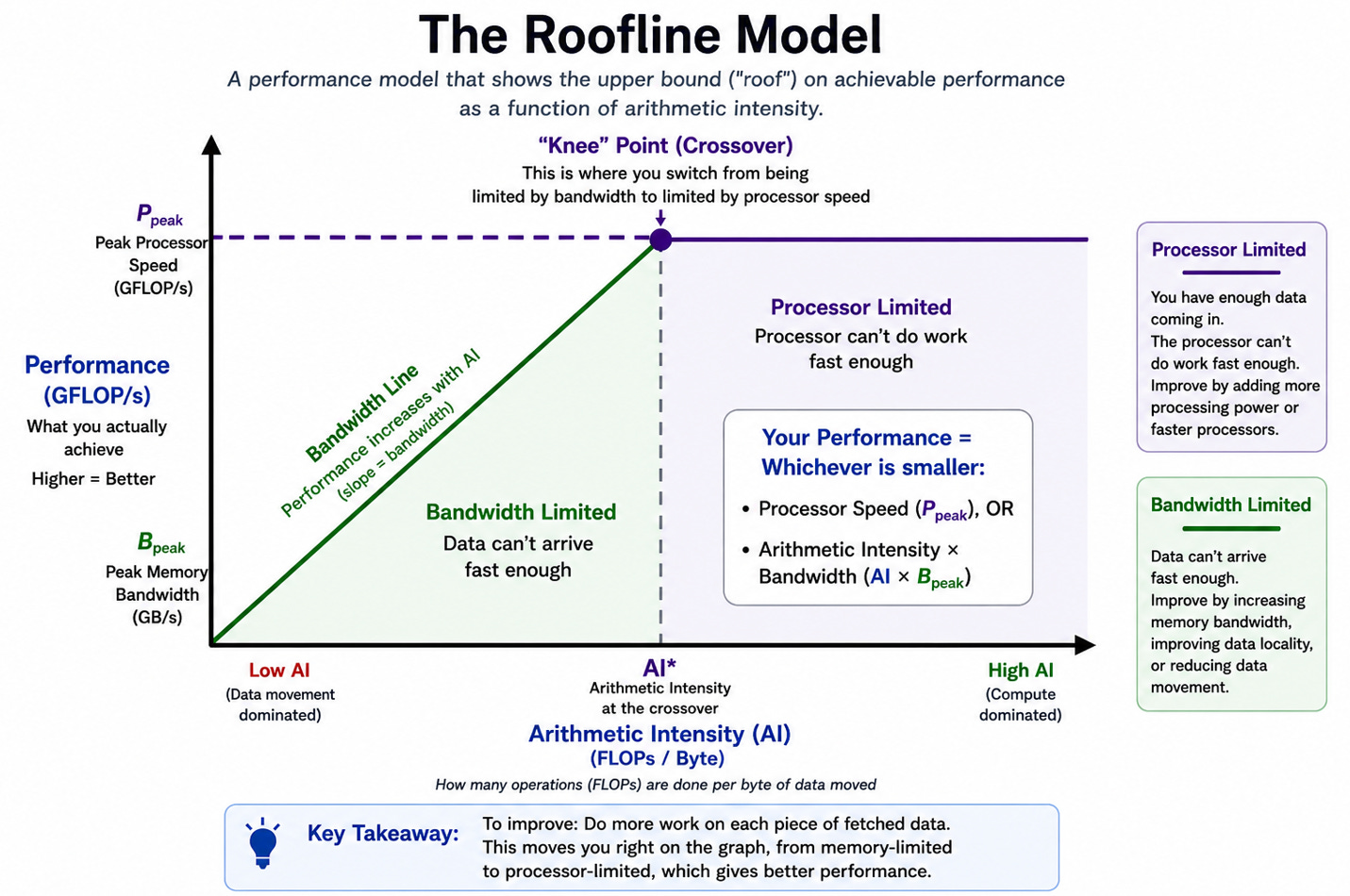
This brings us to a beautiful, elegant concept called the Roofline Model. When software engineers try to make a program run faster, they realize they are always hitting one of two ceilings.
Consider the following scenarios.
If your program only needs to chop the potato in half and then wait for the next one, your chef finishes instantly and goes right back to standing around. You are entirely bottlenecked by the waiter. In computing, we call this being Memory Bound. Your bandwidth is too slow for the work you are trying to do.
But what if your program requires the chef to take that single potato and dice it into a thousand perfectly symmetrical, microscopic cubes? Now, you have high arithmetic intensity. The chef is furiously chopping away, working at absolute maximum capacity. By the time they finally finish that potato, the waiter has already been standing there holding the next one. You are now Compute Bound. Your processor’s physical speed is the bottleneck.
The Roofline Model is simply a graph that plots this exact dynamic, allowing engineers to visualize exactly where their software is getting stuck. Are they waiting on the waiter, or are they waiting on the chef?
The next time you click an icon and your computer hangs for a fraction of a second, just remember: somewhere deep inside that machine, a world-class chef is probably just waiting on a potato.
That’s a wrap for today. I hope you enjoyed reading the article, understood it, and before I say goodbye for today, here’s a quote from Seneca I’ve been pondering,
“If you do not know which port you are seeking, no wind is favorable.”
If you’ve made it this far, please don’t forget to share it with your friends, family, and strangers.
Have a Great Day 💖